Choosing IoT Connectivity: Cellular, LPWAN, Wi-Fi and Wired
The Question Behind the Question
Nobody chooses a radio because of its radio performance. They choose it because of three things that have nothing to do with the physical layer: whether the device has mains power, whether you control the ground the devices sit on, and what the connectivity costs per device per month for the next five years. Get those three straight and the shortlist usually writes itself.
Everything below is organised around that, rather than around a league table of range figures. Range figures are the easiest thing to publish and the least useful thing to plan with, because the number that matters is the one you measure on your own site.
Start With Power
The first question splits the field in half, and it is not negotiable.
A device with mains power can use anything. Wi-Fi, Ethernet, PoE, a cellular router, a wired fieldbus: they are all on the table, and the decision comes down to what infrastructure already exists in the building. If there is a cable tray running past the machine, wired is almost always the cheapest and most reliable answer, and the fact that it is unfashionable does not make it wrong.
A device on a battery rules out most of that immediately. Wi-Fi associating with an access point costs somewhere between 100 and 400 mJ per exchange, which is why a Wi-Fi sensor on two AA cells lasts weeks rather than years unless it is reporting once a day. Bluetooth Low Energy is genuinely low power but only reaches tens of metres, so it needs a mains-powered gateway within earshot of every device. That leaves the low-power wide-area technologies, which exist for exactly this case: a few hundred bytes a day, kilometres of range, and years on a cell.
Solar looks like it moves a device from the second category to the first. It does not, quite. Solar sizing is done against the darkest month of the year at your latitude, not the average one, and a panel large enough to run a Wi-Fi device through a Northern European December is a piece of infrastructure in its own right. Assume solar buys you a generous version of the battery budget rather than mains power.
Who Owns the Network
The second question is commercial, and it is the one that decides the five-year bill.
You own it. Buy gateways, run a server, and the infrastructure is yours: no monthly fees, no carrier contract, no dependency on a third party's business decisions, and data that stays on your own servers. This works when the devices sit on ground you control, a building, a campus, a farm, a factory, a city district. It stops working the moment devices need to be somewhere you cannot install a gateway.
A carrier owns it. You pay per device per month and the coverage is somebody else's problem, which is a genuine advantage when devices move or are scattered one to a site across a region. The cost is that the price is theirs to change and the technology is theirs to retire, and several carriers have already deprioritised NB-IoT in favour of LTE-M.
A vendor owns it. Some platforms sell connectivity as a service on their own infrastructure. This is the most convenient option to start with and the least recoverable one to leave, because you can neither extend the coverage nor take the network with you.
The Options, Honestly
Wired: Ethernet, PoE, Modbus RS485
Still the right answer more often than the industry admits. Inside a plant or a machine room, an RS485 run daisy-chained between meters costs a few euros a metre and never drops a reading, and PoE gives an edge device both power and data on one cable. The reason to move away from wired is the cost of putting the cable in, not the cable itself: trenching a yard, drilling through a listed façade or working in an occupied tenancy is where the quotation goes wrong. If the cable route already exists, use it. See the industrial retrofitting article for how legacy fieldbus equipment gets bridged onto a modern pipeline.
Wi-Fi
Cheap silicon, no new infrastructure, and every building already has it. Also the most over-used choice in IoT. The problems are practical rather than technical: the IT department owns the network and will reconfigure it without telling you, the access points do not reach the basement plant room or the far end of the yard, and the power cost rules out battery operation for anything reporting more than a few times a day. Where it works well is mains-powered equipment inside a building whose network you control, in which case it is hard to beat on cost.
Bluetooth Low Energy
The right tool for short range and high device counts. A BLE beacon broadcasting an identifier runs for years on a coin cell and costs a few euros, which is what makes tracking thousands of pallets, tools or bins economical when GPS trackers would only ever be justified for the highest-value items. It needs a mains-powered scanner within tens of metres of everything, so it is a layer inside a larger system rather than a system on its own.
Cellular: LTE-M and NB-IoT
Cellular removes the coverage problem and replaces it with a subscription. LTE-M carries more throughput, supports voice and mobility properly, and handles handover between cells, which makes it the better choice for anything that moves. NB-IoT is the narrower, cheaper, more power-frugal sibling, deployed as an overlay on existing LTE infrastructure.
Indoor penetration on NB-IoT is good, thanks to sub-GHz operation in some bands, but coverage depends entirely on your carrier's rollout, and that varies dramatically by region. Rural coverage is often nonexistent, because carriers build where the business case is strongest. Battery life is comparable to LPWAN on paper at 5 to 10 years, but real-world results vary: the cellular protocol stack is more complex and devices must maintain carrier registration, which costs more energy than a simple wake, transmit, sleep cycle.
Ownership is the sharp difference, and there is no nuance in it. You do not own the network. You pay a per-device fee to a carrier, and if that carrier raises prices, changes terms or discontinues the service in your region, your deployment is at their mercy. Every unit also needs a SIM and carrier provisioning before it can say anything, which is a real logistics cost at volume.
It is still the right answer in three situations. Devices that move between cities or countries suit it, though roaming adds cost and complexity. Deployments where carrier-grade service guarantees are required by regulation need it. And any site where installing your own infrastructure is genuinely impossible leaves you no alternative.
LPWAN on unlicensed spectrum: LoRaWAN
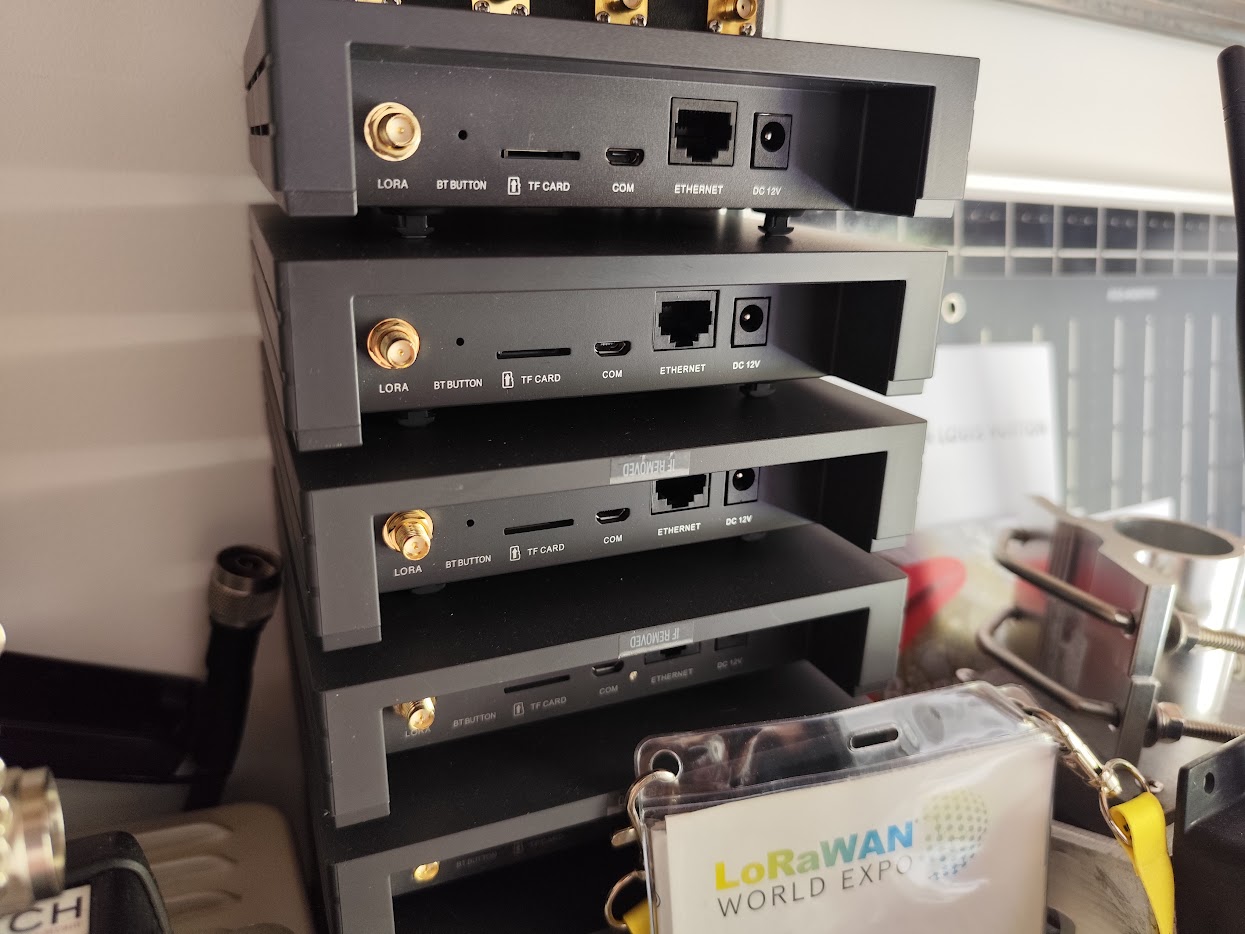
The unlicensed sub-GHz bands, 868 MHz in Europe and 915 MHz in North America with regional plans elsewhere, are what let you build the network yourself. That is the defining characteristic, and everything else follows from it.
On range it achieves 3 to 15 km in rural environments and 1 to 5 km in dense urban areas, and the sub-GHz frequency gives building penetration that higher-frequency protocols cannot match, reaching basements, parking garages and plant rooms. Indoors a single gateway covers 3,000 to 5,000 square metres through concrete, steel and multiple floors. Devices reach 5 to 10 years on one battery by spending nearly all their time asleep and waking briefly to send payloads of 51 to 241 bytes, which is ample for temperature readings, meter pulses, GPS coordinates and status.
Around it sits an ecosystem large enough to make vendor lock-in a choice rather than a fate: an open standard, more than 200 certified device manufacturers, and no obligation to buy hardware, server software and network infrastructure from the same supplier. Security is in the protocol rather than bolted on, with two layers of AES-128, so even a network operator cannot read the payloads.
The cost is the mirror of the benefit. You are responsible for coverage. A device that wanders off your gateways goes silent, and a site too small to justify a gateway of its own is a site where cellular is cheaper.
Sigfox and other operated LPWANs
Sigfox operates its own global network on unlicensed bands and sells connectivity as a service. Range is excellent where coverage exists, up to 50 km with rural line of sight, and battery life is outstanding, because the ultra-simple protocol has no handshake and no acknowledgment by default. But coverage is binary. Either there is infrastructure in your area or there is not, and you cannot extend it yourself.
The limits are what usually decide the matter. A device may send 140 uplink messages per day with 12-byte payloads, and receive 4 downlink messages of 8 bytes. That rules out anything needing frequent transmission, firmware updates or real-time control, and it means you cannot meaningfully send commands to a device at all. The deployment also rests entirely on one company's infrastructure and continued solvency, and Sigfox has been through financial difficulty, a change of ownership and revised pricing, each of which lands directly on everyone built on top of it.
Head-to-Head: The Long-Range Options
| Feature | LoRaWAN | NB-IoT | LTE-M | Sigfox |
|---|---|---|---|---|
| Spectrum | Unlicensed (free) | Licensed (carrier) | Licensed (carrier) | Unlicensed (operated) |
| Range (rural) | 5-15 km | 10-15 km | 5-10 km | 10-50 km |
| Range (urban) | 1-5 km | 1-5 km | 1-5 km | 3-10 km |
| Battery life | 5-10 years | 5-10 years | 2-6 years | 5-15 years |
| Data rate | 0.3-50 kbps | 26-127 kbps | up to 1 Mbps | 100 bps |
| Payload size | Up to 241 bytes | Up to 1600 bytes | Unrestricted | 12 bytes |
| Messages/day | Unlimited* | Unlimited | Unlimited | 140 up / 4 down |
| Mobility/handover | No | Limited | Yes | No |
| Private network | Yes | No | No | No |
| Per-device fee | None (private) | Monthly SIM | Monthly SIM | Annual subscription |
| Firmware updates | Over-the-air | Possible | Yes | Not practical |
| Encryption | AES-128 (2 layers) | LTE encryption | LTE encryption | Basic |
*Subject to regional duty cycle regulations, such as the 1% duty cycle in EU868.
Which One, and When
Wired wins whenever the cable route already exists, and loses whenever it does not.
Wi-Fi wins for mains-powered equipment inside a building whose network you actually control.
BLE wins for dense, cheap, short-range tagging, as a layer under something else rather than on its own.
A private LPWAN wins when you need to own and control the infrastructure, when data sovereignty matters as it does in healthcare, industry and government, and when you are deploying across a defined area where gateways can be installed. It is also the answer whenever long-term cost predictability matters more than the initial hardware bill, and when indoor penetration into basements, plant rooms and parking garages is a hard requirement rather than a nice-to-have.
Cellular wins when devices are mobile across wide geographic areas, when carrier-grade service level agreements are legally required, when you cannot install any infrastructure at all, or simply when the carrier has strong coverage exactly where you are deploying and you have too few devices per site to justify a gateway.
An operated LPWAN wins for very simple, very infrequent readings in an area already covered, where nothing ever needs to be sent back to the device.
And plenty of real deployments use two at once: a private network on the sites that justify one, cellular on the outliers, and the same ingest pipeline behind both. That hybrid is often the cheapest total answer, and it is rarely the one a single-technology vendor will propose to you.
The Total Cost Reality
Hardware is only part of the equation, and over a five-year deployment the shape of the spending matters more than its size.
A private LPWAN deployment is front-loaded and predictable: roughly 300 to 600 EUR per gateway plus 20 to 100 EUR per device, with the server running on a basic Linux machine and no recurring per-device fee at all if you self-host.
Cellular inverts that. Hardware per device is often cheaper up front, but every device carries a monthly fee of roughly 0.50 to 5 EUR depending on carrier and volume. Run the arithmetic on a thousand devices at 2 EUR a month over five years and it comes to 120,000 EUR in connectivity fees before counting a single device, and that line never stops.
Sigfox devices are cheap with an annual subscription of 1 to 7 EUR each, but the 140-message daily limit and 12-byte payload restrict what can be built on top, and many projects outgrow those limits inside the first year, at which point the migration cost arrives all at once.
The crossover is worth calculating rather than guessing, and it moves with device density. Twenty devices spread across twenty sites will almost always be cheaper on cellular. Two thousand devices across one campus will almost always be cheaper on infrastructure you own. The total cost of ownership article works through the full five-year arithmetic on both sides.
What I Provide
I help organisations evaluate connectivity options against their actual requirements, then design and deploy the one that fits, and that conversation regularly ends with cellular or plain wiring being the better answer than the wireless network the client came in asking about. Where a private network is right, the work covers coverage surveys and gateway placement, server configuration, device provisioning, the data pipeline and the dashboards on top, delivered with full source code and documentation. No vendor lock-in, no recurring platform fees.
Working on something like this?
If this article touches on what you are building, tell me about it. The first conversation is free, and you will get an honest read on the right approach for your situation.
Book a free consultationCurious what the finished thing looks like? Open the live demo dashboard