Your Air Quality Sensor Is Not Measuring CO2
Two Numbers With the Same Name
Order an air quality module and there is a fair chance the carbon dioxide figure it reports was never measured. It was calculated, from a completely different measurement, by a sensor that cannot detect carbon dioxide at all.
The honest name for that output is equivalent carbon dioxide, usually written eCO2, and the "equivalent" is doing an enormous amount of work. The underlying part is a metal oxide gas sensor measuring volatile organic compounds: the broad family of carbon-containing gases that evaporate at room temperature, emitted by paint, solvents, cleaning products, cooking, furniture, and by people. The chip measures total VOC and then applies a model that turns it into a plausible carbon dioxide figure.
The model works because of a coincidence rather than a mechanism. People exhale carbon dioxide and people also emit VOCs, continuously, from skin and breath. In an ordinary occupied room the two rise and fall together, so a VOC reading scaled appropriately looks convincingly like a carbon dioxide curve.
A measured sensor is doing something entirely different. It is detecting the specific wavelength at which carbon dioxide absorbs infrared light, which nothing else in the air absorbs in the same way. The reading is of the gas itself, and it is indifferent to what else is in the room.
Where the Coincidence Breaks
The correlation holds until something in the room emits VOCs without emitting carbon dioxide, at which point the inferred number does not degrade gracefully, it becomes fiction.
A cleaner walks through with a spray bottle and the eCO2 reading spikes into what a dashboard will present as dangerous overcrowding, in an empty corridor. Somebody uses hand sanitiser next to the sensor and the alcohol produces the same effect. A kitchen, a print room, a laboratory or a workshop produces a permanently elevated baseline that has nothing to do with how many people are present. New furniture, fresh paint or a recently laid floor will outgas for weeks and hold the reading high the entire time.
The reverse failure is quieter and worse. A well-ventilated room where the ventilation is removing VOCs efficiently can report comfortable air while carbon dioxide is genuinely climbing, because the model is being fed the wrong variable.
There is a further problem with using these parts as an absolute reference at all, which is that most of them normalise against their own recent history. The output is closer to a statement about how this room compares with itself over the past day than a measurement of anything. That is genuinely useful for detecting change, and it is not something you can compare between two rooms or report in a document.
A VOC sensor is a good instrument answering a different question. The failure is not the sensor, it is the label on the dashboard that says CO2, and the ventilation decision made downstream of it.
What the Numbers Actually Mean
Assuming a measured reading, the interpretation is more straightforward than most guidance makes it sound.
Outdoor air is currently a little over 400 parts per million and rises by a couple each year, which is worth knowing because it is the floor: no amount of ventilation takes an indoor space below the air outside it. A well-ventilated occupied room sits somewhere in the 500s to 700s. Around 800 is comfortable and unremarkable. Somewhere between 1000 and 1400 is where most national and professional guidance places a threshold at which ventilation should be improved, and the exact figure varies by country and by what the space is for. Above about 1500 the air is demonstrably stale, and people begin reporting the drowsiness and difficulty concentrating that studies have repeatedly associated with this range.
Two caveats stop these numbers being over-read.
In an ordinary occupied room, carbon dioxide is not the thing doing you harm at the concentrations involved. It is a proxy for how much of the air has already been through somebody's lungs, which is what makes it a reasonable indicator both of ventilation adequacy and, since the pandemic made this a mainstream concern, of shared airborne exposure. The gas is the messenger.
That stops being true in spaces where carbon dioxide is produced or stored rather than merely exhaled. Cellars, fermentation rooms, anywhere using it as a refrigerant or a process gas, and any confined space can reach concentrations that are genuinely dangerous, and occupational exposure limits exist for exactly that reason. Those are not air quality monitoring problems, and the last section of this article says what they are instead.
And the number is meaningless without occupancy. An empty room at 900 parts per million has a ventilation problem. A room with thirty people in it at 900 is doing rather well. Any threshold alert that does not account for this will spend its life firing on the wrong rooms.
Which One Belongs Where
The choice is genuinely about the job, and both parts have honest uses.
Anything that drives a ventilation rate needs a measured sensor. Demand-controlled ventilation adjusts a real mechanical system on the strength of this number, and a control loop fed an inferred value will eventually chase a bottle of cleaning fluid. The same applies to anything reported to a landlord, a regulator or a tenant, where the provenance of the number has to survive somebody asking how it was obtained.
VOC sensing earns its place where the question is actually about chemicals. Detecting a solvent leak, catching a cleaning regime that is overwhelming a space, monitoring a print room, or picking up cooking and combustion events are all things a carbon dioxide sensor is blind to and a VOC sensor does well. Reported as what it is, total VOC or an index, it is genuinely informative.
The two together are better than either, which is why the combined modules exist. Just present them as two measurements rather than blending them into one number with a misleading name.
For anything safety-related the answer is neither. A confined space, a cellar, a brewery or a plant using carbon dioxide as a refrigerant needs a certified fixed gas detector with an alarm, a service schedule and a calibration certificate. Air quality sensors are not that, whatever their accuracy.
Buying Without Being Misled
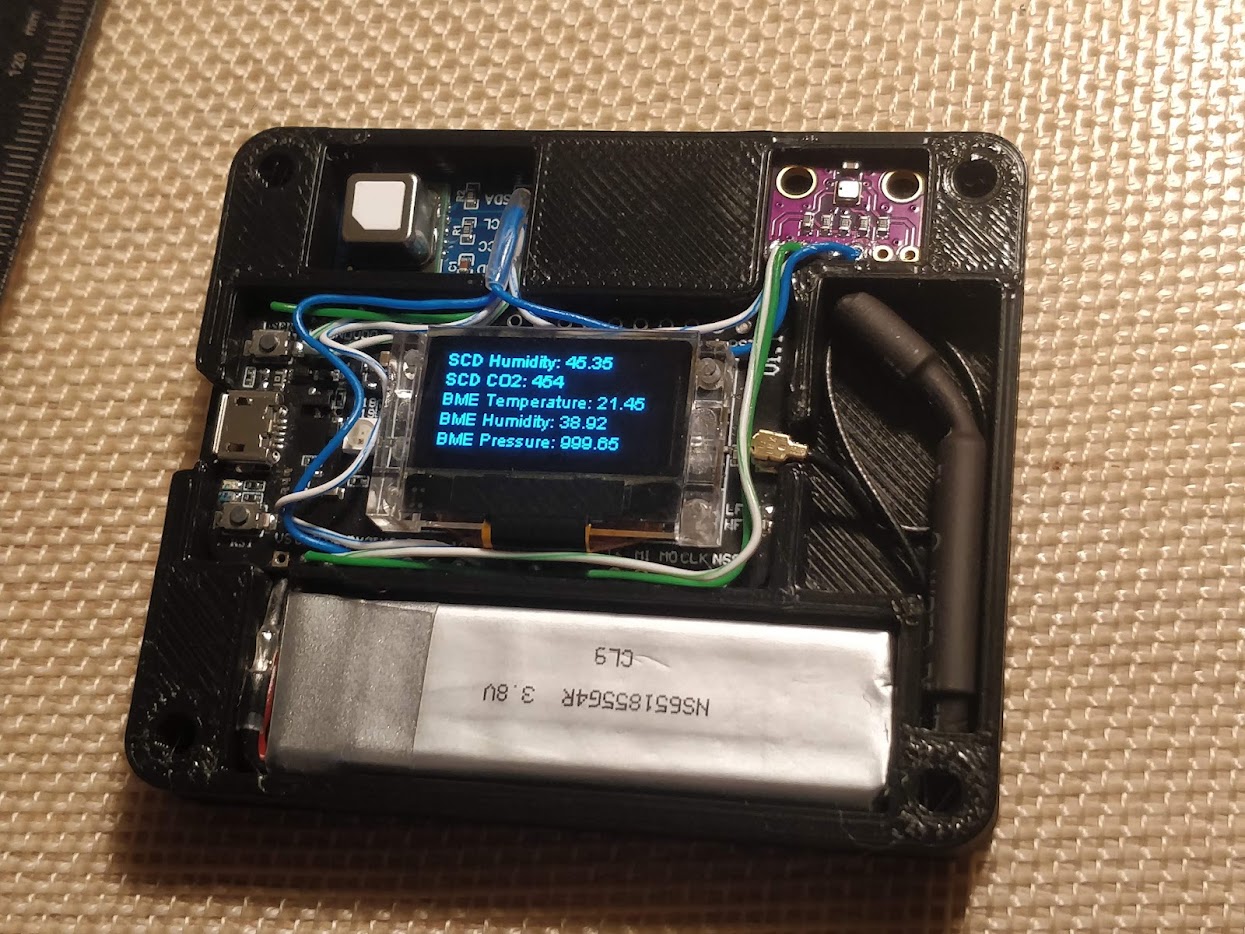
The vocabulary in product listings is not reliable, so a few questions settle it quickly.
Ask what the sensing principle is. An answer naming an optical or photoacoustic technique is a measured sensor. An answer about metal oxide, gas resistance, VOC or "equivalent" is an inferred one. A supplier who cannot answer at all has told you what you needed to know.
Look at the specified range and the units. A measured part quotes an accuracy as a figure in parts per million plus a percentage of reading. An inferred one often quotes an index, a vague band, or nothing.
Check the price against the physics. A measured sensor contains an optical path or a microphone and a modulated emitter, and it costs an order of magnitude more than a metal oxide element. A module offering carbon dioxide for a few euros is not measuring it.
And be careful with combined modules, which frequently contain a genuine measured element alongside a VOC element and report both. That is the good case. The bad case is a module reporting eCO2 in the same list as real measurements, which reads as though everything on the list has the same standing.
What I Provide
Most of my involvement here is at specification stage, and it is often a short conversation that saves an expensive one later. If the sensor is going to drive plant, feed a report or appear in front of a tenant, it needs to be a measured part, and the SCD article covers choosing between them and the calibration behaviour that decides whether the readings stay trustworthy.
Beyond the part choice there is the work of making the number useful: placement that characterises the room rather than the person nearest it, thresholds set against occupancy instead of a flat number, and dashboards that report what was measured rather than what was inferred. Where a building already has sensors in it, an afternoon establishing which of them are measuring and which are estimating is usually the highest-value thing that can be done with the existing hardware.
Does this describe your project?
If any of the above sounds like something you are dealing with, tell me about it. You will get a straight read on the right approach for your situation, and the first conversation costs nothing.
Start a conversationPrefer to see the finished thing first? There is one running on real devices