What a Particulate Sensor Is Actually Counting
Counting Flashes, Not Weighing Dust
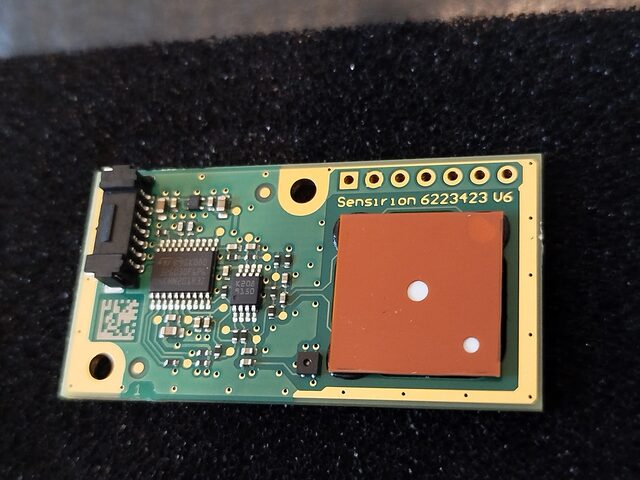
An optical particulate sensor works by pulling air through a chamber with a small fan, shining a laser across the stream, and watching the flashes as particles cross the beam. The rate of flashes gives a count. The brightness and duration of each one give an estimate of size. From the size distribution the firmware calculates a mass concentration and reports the familiar figure in micrograms per cubic metre.
That last step is where all the interesting problems live, because mass was never measured. It was derived, by assuming something about the density and shape of the particles and about how efficiently the inlet captured them.
The reference method that regulations are written against does something quite different. It draws a known volume of air through a filter for a defined period, conditions the filter to a controlled humidity, and weighs it. That is an actual mass measurement, and it is a laboratory procedure taking many hours.
Both are legitimate. They are not the same measurement, and the gap between them is not a defect in the cheap one. Understanding where they diverge is what separates a deployment producing useful data from one producing numbers nobody can defend.
Humidity, and What the Sensor Already Did About It
Water is the complication that dominates the literature on low-cost particulate sensing, and it is worth being precise about it, because the received wisdom is drawn largely from a generation of sensors that handled it badly.
The physics is not in dispute. Many airborne particles are hygroscopic and absorb water from the air, so as relative humidity climbs a particle physically grows. A larger particle scatters more light, and an optical instrument reports it as larger, because it is. The reference method never sees this, since conditioning the filter drives that water off before weighing. So a raw scattering measurement and a gravimetric one are describing genuinely different things at high humidity.
What varies enormously is whether the sensor does anything about it. The uncompensated modules that most of the published evaluation work is based on report essentially raw derived mass, and on those the effect is severe: a characteristic diurnal shape where the reading climbs as the evening cools, peaks near dawn when humidity is highest, and falls back through the morning, with nothing having burned and no change in air quality.
Sensirion's parts do not behave that way. The compensation is applied inside the sensor, informed in the combined modules by an on-board humidity measurement, and the mass concentration you read out has already been conditioned.
The SEN55 is the best of them that I have deployed, and its residual humidity dependence is low enough that I no longer treat it as a term worth chasing. It is not the first thing I look at when a reading surprises me, and on units that have been out through several wet winters it has not been the answer. If one of these shows a large overnight excursion, the cause is much more likely to be something real: a nearby boiler cycling, an inversion trapping traffic emissions at ground level, or somebody's wood burner.
Two things survive the compensation, and they are different in kind.
The first is condensation and fog, where the air contains actual suspended droplets. Those are not dry particles that have swollen, they are water, and any optical instrument counts them because they are physically present and scattering. That is not a compensation failure; it is the sensor correctly reporting something the gravimetric reference would have evaporated away. Deployments near coasts, rivers and cooling towers see this and it is worth annotating rather than correcting.
The second is that compensation is a model, and models are built against assumed aerosol composition. In an environment whose particles are unusual, heavy sea salt loading, an industrial process with its own chemistry, the correction is working from assumptions that do not hold. It will still be far better than nothing.
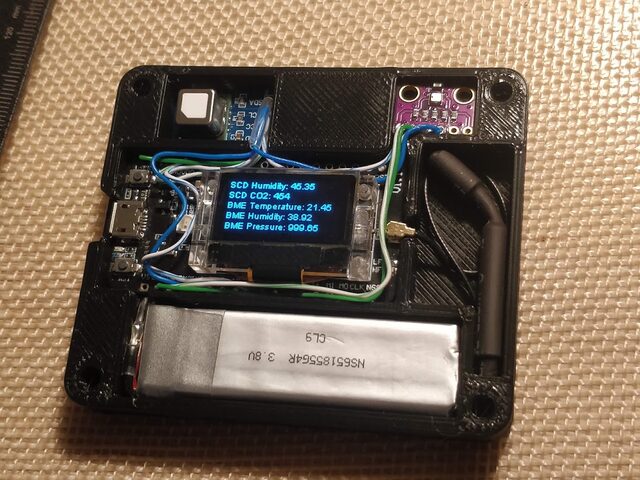
None of which changes the practical instruction, which is to log relative humidity alongside every particulate reading regardless. Not because you will necessarily need to correct anything, but because when a reading is later disputed, humidity is the first thing you will want to overlay, and a dataset without it cannot even be interrogated.
The right question is not whether humidity affects an optical particulate reading. It is whether your sensor already accounted for it, because the answer differs by an order of magnitude between parts and decides whether you are looking at an artefact or at air.
Which Size Channels Mean Anything
Most of these sensors report several channels: PM1, PM2.5, PM4 or PM10, and often particle number as well as mass. They do not all carry equal weight.
The fine end is where the technique is strongest. PM1 and PM2.5 are the sizes the optics are designed around, they dominate the count in most environments, and the readings track a reference reasonably well once humidity is accounted for. This is fortunate, because the fine fraction is also the one with the clearest health significance, being small enough to reach deep into the lungs.
The coarse end is weaker, for a physical reason that no amount of processing removes. Large particles are heavy, they settle out, and a small inlet with a modest fan draws them in less efficiently than it draws in fine ones. Vendors do specify the coarse channels, with a wider tolerance than the fine ones, so this is a question of degree rather than a channel to disregard. But in an environment dominated by coarse material, construction dust, agricultural work, road grit, the sensor is working furthest from its strength, and a low reading there should not be read as evidence of clean air without something else to corroborate it.
Particle number is the least processed output and is worth logging even if nobody looks at it. It has had fewer assumptions applied to it than the mass figures, so when a reading is later disputed, the count is what lets you work out what actually happened.
Living With a Moving Part
The fan is the only mechanical component in an otherwise solid-state device, and it defines the maintenance story.
Continuous operation gives good time resolution and consumes the fan's life fastest. Duty cycling, waking the fan for a minute every quarter hour, extends life considerably and costs the ability to see short events. If the point of the deployment is catching cooking, welding or a passing vehicle, duty cycling will miss most of them. If the point is a daily average for a building or a district, it is straightforwardly the better choice, and it saves power that a battery device does not have.
There is a subtlety that catches people out: after starting, the fan needs to establish flow and flush the chamber before the readings are meaningful. Firmware must discard the first several seconds of every wake cycle. A device that reports its first sample gets a low reading every time and produces a data set with a systematic downward bias that looks like nothing in particular.
These sensors also run a periodic cleaning cycle, spinning the fan hard to clear the optical chamber. Let it run, schedule it for a quiet period, and treat a unit whose readings are drifting downward over months as one whose chamber is dirty rather than one whose sensor has aged.
Putting One Outdoors
The housing is where most outdoor particulate deployments fail, because it has to do two contradictory things: admit the air being measured and exclude the water.
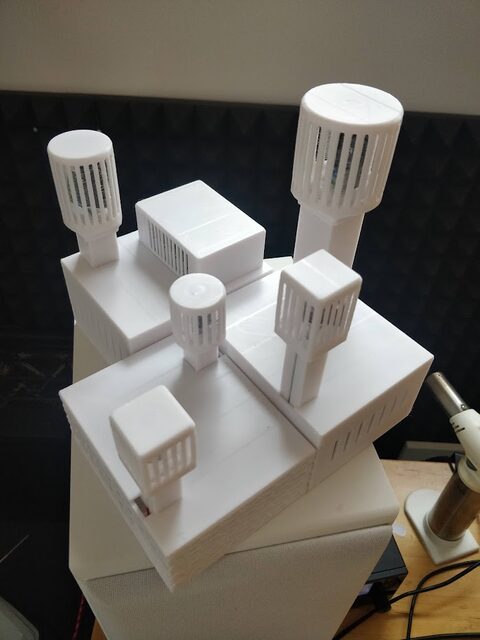
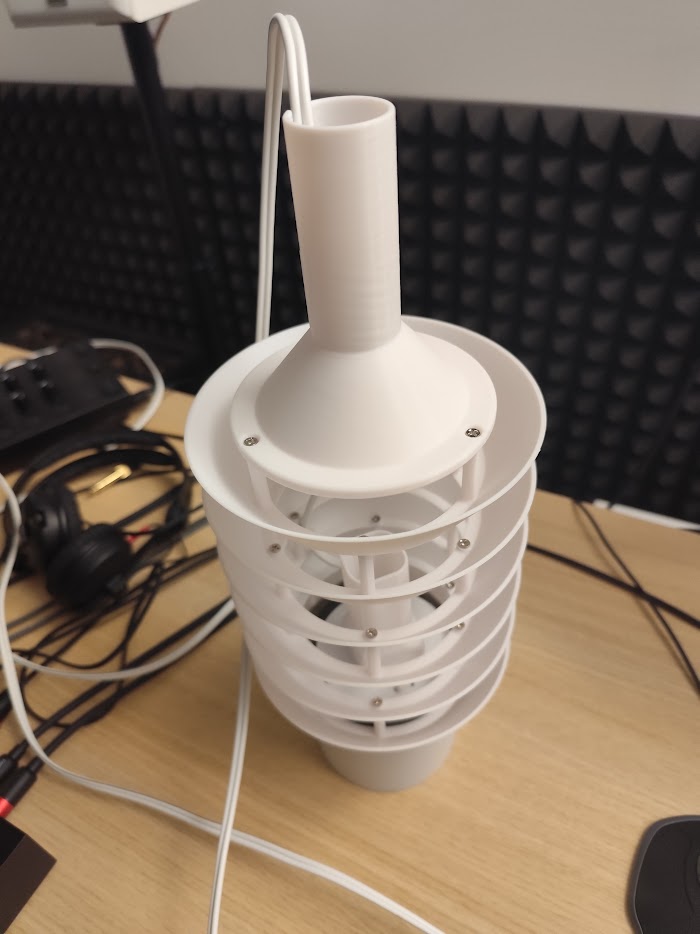
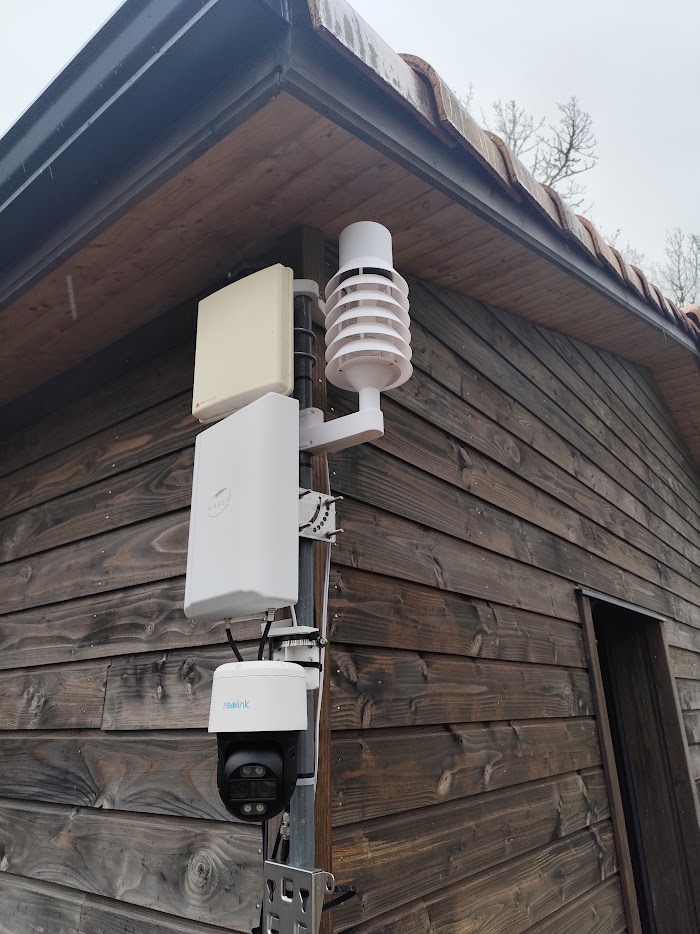
The inlet needs to face downward or sideways under an overhang so that rain cannot fall into it, and the internal path needs somewhere for any water that does get in to leave. A gooseneck or a labyrinth achieves both. What must not happen is condensation inside the optical chamber, which will read as a dense pollution event and, if it persists, will damage the optics.
The device also has to breathe as it heats and cools through the day, which for a sealed box means a membrane vent, and it needs the enclosure not to be a chimney, since air warmed by the sun rising through the case is not the air outside.
Placement follows the usual rules and they are worth respecting because siting errors dominate. Away from a road by a sensible margin unless the road is the subject. Not next to an extract fan, a flue or a car park entrance. At breathing height rather than at ground level or roof level, and consistent across sites, because comparing two units at different heights is comparing two different things.
Being Honest About the Numbers
Low-cost particulate sensors are excellent at some jobs and unsuitable for others, and the distinction is about how the output is used rather than how good the sensor is.
They are very good at relative measurement. Comparing this room with that one, this hour with the same hour yesterday, before a change against after it, or finding which of twenty locations is worst. Errors that are systematic across the fleet cancel out in a comparison, which is why a network of modest sensors can produce genuinely valuable spatial data.
They are good at event detection. Cooking, smoking, a machine running, a nearby fire, a dusty process starting. These produce changes far larger than the measurement uncertainty, and detecting them reliably is worth a great deal operationally.
They are not a compliance instrument. Where a number has to satisfy a regulator or stand up in a dispute, the reference method is the reference method, and no amount of correction makes an optical sensor into one.
Where an absolute figure is genuinely needed, the workable approach is co-location: park a few of your units alongside a reference instrument, ideally a regulatory monitoring station if one is nearby, for several weeks covering a range of humidity and concentration. Derive a correction from that comparison, apply it, and, crucially, publish the method alongside the data. A corrected reading whose provenance is documented is defensible. The same number presented as though it came from a reference instrument is not, and that gap is where the reputational risk in these projects sits.
What I Provide
I build these into devices and into networks, and the work is mostly the parts above rather than the sensor itself: choosing a part whose compensation you can rely on, logging humidity beside it so a surprising reading can be interrogated later, a housing that admits air and rejects water, a duty cycle chosen against what the deployment is actually looking for, and firmware that discards the settling period rather than reporting it.
Where an absolute claim is needed I run the co-location and derive the correction, and where it is not, I will say so and save you the exercise. The measurement is genuinely useful, and the fastest way to make it useless is to present it as something it is not. On sites with no mains or network, the additional constraints are in the off-grid article, and the fan is usually what decides the power budget.
Does this describe your project?
If any of the above sounds like something you are dealing with, tell me about it. You will get a straight read on the right approach for your situation, and the first conversation costs nothing.
Start a conversationPrefer to see the finished thing first? There is one running on real devices