The Leak That Ran All Summer
Nobody Notices Water
Water is cheap enough per unit that it escapes attention and expensive enough in aggregate to matter, which is exactly the combination that produces a leak running for a whole season before anybody investigates.
The arithmetic is unforgiving once you write it down. A modest fifty litre per hour leak, the kind a failed float valve or a cracked underground joint produces, is 1,200 litres a day. Found in two hours it has cost a hundred litres. Found at the next quarterly reading it has cost over a hundred thousand, plus whatever the water did to the building on its way out, which is frequently the larger number.
The reason it goes unfound is not that it is hard to detect. It is that the only measurement anybody takes is a quarterly total from one meter, and a hundred thousand litres hidden inside a site's annual consumption looks like an ordinary variance.
The Overnight Baseline
The single most useful thing sub-metering produces is not a total, it is the flow rate at four in the morning.
Almost every site has hours when consumption should be zero or near it. An office at night, a factory between shifts, an apartment block in the small hours, an irrigated block outside its watering window. Whatever water is moving during those hours is either a genuine standing demand you can name, or a leak. There is no third category, and that is what makes the measurement so powerful: it converts leak detection from an investigation into a threshold.
The baseline also tells you what kind of problem you have. A step change from zero to steady flow that starts one night and never stops is a fitting that failed. A slow creep upward over months is a seep getting worse. A brief high-flow event at three in the morning is a solenoid or a pressure relief cycling. Each has a different urgency and a different trade to call, and you can tell them apart from the data without leaving the office.
A leak is not detected by measuring how much water a site uses. It is detected by measuring water moving at a time when none should be, which is a completely different and much easier question.
Which Meter, and Why Accuracy Is Not the Point
Two families of instrument, and the choice is dominated by whether you can shut off the supply.
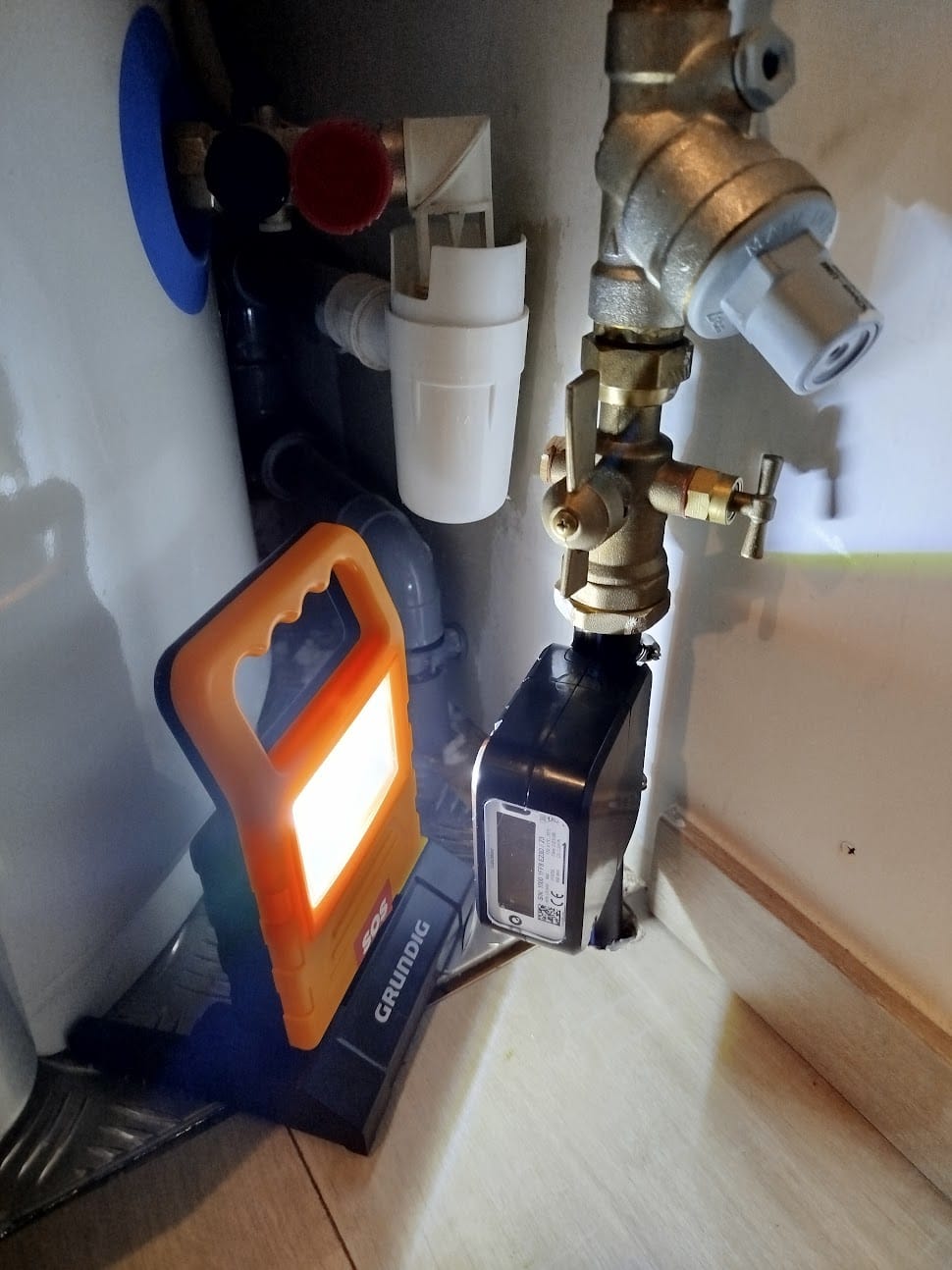
A mechanical meter with a pulse output is the proven option: available from small domestic sizes up to large industrial diameters, accurate, and understood by every plumber. It emits an electrical pulse per unit of volume, typically one per litre or ten per litre where you want the resolution, and a wireless pulse transmitter wired to that output reports accumulated totals on an interval and derives a rate from the timing. Nothing about the meter changes and its certification is untouched.
The catch is installation. Fitting one means cutting the pipe, threading it, coordinating a shutdown and paying a plumber, which is why mechanical meters suit new construction, planned refurbishment and anywhere the plumbing work is happening regardless. Budget the meter plus the transmitter plus the plumber, and the plumber is often the largest of the three.
A clamp-on ultrasonic meter avoids all of that. It measures flow by timing ultrasound across the pipe wall, so it fits from outside, the supply stays on, and the whole job is twenty minutes once you have found a suitable spot. That single property is why retrofitting a whole building becomes possible.
What you give up is precision. A clamp-on unit on copper is typically within twenty percent, on plastic within ten, which sounds alarming until you remember what the measurement is for. Detecting that eighty litres an hour are moving when nothing should be does not care whether the true figure is seventy-two or eighty-eight. Tracking that a unit's consumption doubled month on month does not either. It is only billing that needs better, and billing needs approval rather than accuracy.
The requirement the datasheet omits is straight pipe. A clamp-on meter needs a clear run before and after it, conventionally ten pipe diameters upstream and five downstream, because turbulence from a bend or a valve corrupts the timing. For a 20 mm pipe, that works out at a fifth of a metre of clear run ahead of the sensor and half as much behind it. Finding that run is the actual site survey, and a plant room with a bend every 150 mm is a plant room where the mechanical option wins after all.
Zoning Decides What You Can Find
Where the meters go matters more than which meters they are, and this is the part that gets least thought.
One meter on the incoming main tells you the site has a leak. It does not tell you where, which means somebody walks the site with a listening stick. Two meters splitting the site in half tell you which half. A meter per building, riser or process tells you which one, and at that point the investigation is a room rather than a campus.
The useful principle is to meter at the boundaries that matter administratively, because those are the boundaries you will want to compare and bill against anyway, and then add meters at the branches where a leak would be most expensive or hardest to see. Underground runs and anything buried under a slab deserve their own meter, because those are the leaks that do damage before they surface.
There is a nesting check worth building in from the start: the parent meter should read approximately the sum of its children. When it stops doing so, the difference is either a leak between them or a meter that has failed, and both are things you want to know. That single comparison catches more problems than any threshold alert.
Alert Rules That Actually Fire Usefully
Four rules cover almost everything, and each needs a different shape.
Flow during a declared quiet window is the baseline rule and the most valuable. It needs the quiet window defined per meter, because an apartment block and a factory have different ones, and it needs a small tolerance so a single cistern refilling does not page anyone.
A sustained high flow is the burst rule, and it is the one where minutes matter. Above some multiple of normal peak for more than a few minutes, notify immediately, because the failure mode here is a pipe discharging into a building rather than into a drain.
A month-on-month step change catches the slow deterioration that no instantaneous rule sees. It is not urgent, it belongs in a weekly summary rather than an alert, and it is what finds the seep that has been growing since spring.
And a meter that has not reported in a day is a rule about the monitoring rather than the water, which is exactly why it is needed. A dead meter reports nothing, and nothing looks identical to no leak. Without this rule the system degrades into silence and everybody assumes things are fine.
What It Costs and What It Returns
Hardware is modest. A clamp-on ultrasonic unit with the radio built in lands in the low hundreds of euros complete, a mechanical meter plus transmitter is comparable before the plumber, and one gateway covers a building complex or a park.
Installation is where the money is, and it is much lower on the clamp-on route: twenty to thirty minutes against a shutdown and a plumber. That difference is what makes a fifty-meter retrofit affordable and it is the reason the ultrasonic option dominates retrofit work despite being less accurate.
Payback is driven almost entirely by leak reduction rather than by behavioural savings, which is worth being honest about. On industrial and commercial sites I see eight to fourteen months. Agricultural operations tend to run twelve to twenty-four. Municipal systems are slower, eighteen to thirty-six, and usually have a regulatory driver sitting alongside the cost case. Multi-tenant billing accelerates all of these, because the allocation is a revenue effect rather than a saving.
The return that does not appear in the model is the avoided damage. One burst found in twenty minutes instead of overnight is frequently worth more than the entire installation, and it is impossible to forecast and completely real.
Allocation and the Metrology Question
Where consumption is billed to tenants, RV pitches or process owners rather than absorbed centrally, the same meters serve a second purpose and the requirements change.
The technical part is easy. Consumption per unit, a dashboard showing each occupant their own figure, and an export in whatever format the finance system wants. Disputes drop sharply once people can see their own data, which is a benefit that has nothing to do with the accuracy of the meter and everything to do with transparency.
The legal part needs checking first. Billing a tenant for measured water usually requires a legally approved instrument under local metrology rules, and a clamp-on retrofit meter is generally not one. Where that applies, the answer is a certified mechanical meter with a pulse output, which keeps the approval and adds the reporting. Where the charge is an internal allocation rather than a regulated bill, the rules are usually looser. Establish which situation you are in before specifying hardware, because discovering it afterwards means buying twice.
Where This Does Not Help
Sub-metering finds water leaving the pipe network. It does not find water that leaves correctly and is then wasted, a tap left running in a plant room during working hours looks exactly like legitimate use, and no meter placement changes that.
It also cannot localise within a zone. A meter per building narrows a leak to a building, and the last few metres is acoustic detection, thermal imaging or excavation. Metering makes those techniques affordable by telling you where to point them.
And on a very small site the arithmetic does not work. A single-tenant building with one supply and a modest bill is better served by reading the existing meter weekly and writing it in a book, which costs nothing and catches the same step change.
What I Provide
The work starts with a survey, because meter placement is the decision that determines what the system can ever detect, and because finding the straight pipe runs is a physical exercise rather than a drawing exercise. What comes out is a zoning plan with a meter schedule and an honest note about which positions are compromises.
Then the build: installation and verification against a known draw, the baseline established over the first few weeks so that thresholds come from your site rather than a default, the alert rules with their quiet windows, and the storage and dashboards behind them. Where billing is in scope, the allocation output and the export into your finance system, with the metrology question settled up front.
Everything comes with the source code, the documentation and the meter schedule. Water projects tend to start with one question, which is who is using what, and grow into leak programmes and billing, so the system is built to have meters added later without anybody reconfiguring anything.
Does this describe your project?
If any of the above sounds like something you are dealing with, tell me about it. You will get a straight read on the right approach for your situation, and the first conversation costs nothing.
Start a conversationPrefer to see the finished thing first? There is one running on real devices